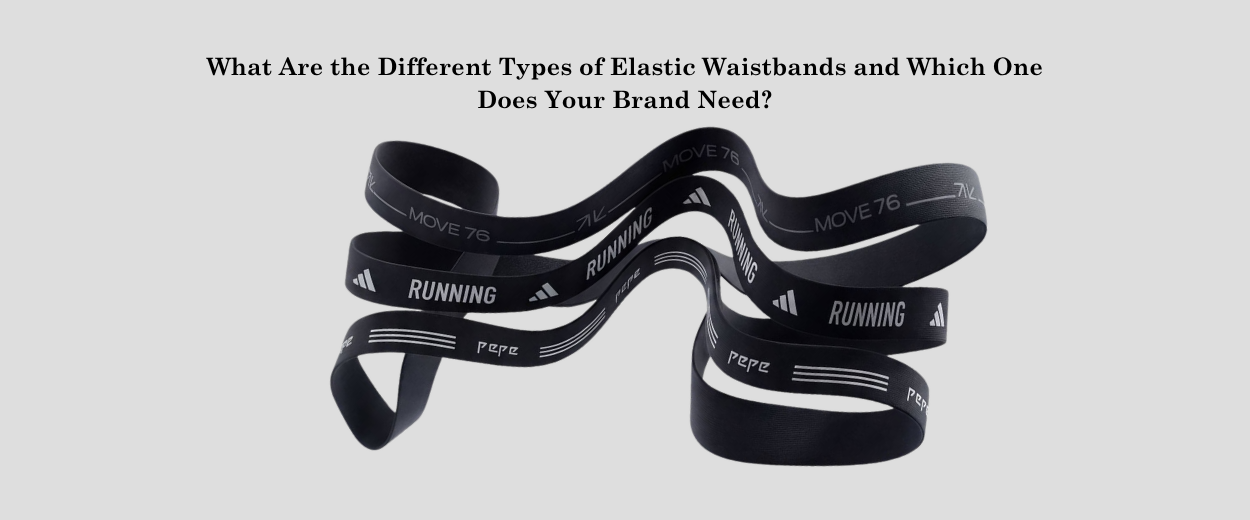
Most innerwear waistbands carry a brand logo. The construction method used to put that logo there determines whether it survives two years of washing or two months of it. Jacquard elastics weave the design into the fabric structure during production. Printed elastics apply it on top afterward. That single difference in sequence drives every downstream difference in durability, hand feel, and long-term brand presentation.
The waistband is the first branded element a consumer interacts with on an innerwear product. It appears in product photography, sits at eye level on a retail hanger, and is the first thing visible when the packaging is opened. After purchase, it is present on every wear. A waistband that holds its construction quality across the life of the garment reinforces the brand positioning that the price point and packaging created. One that fades, puckers, or loses definition within a season quietly undermines it.
Brands building premium innerwear lines consistently choose jacquard construction for their waistbands. The reasons are technical, commercial, and practical. This guide covers the construction logic behind jacquard elastics, the material decisions that determine finished quality, and the sourcing process for getting custom waistband development right the first time.
What Are Jacquard Elastics and How Are They Made
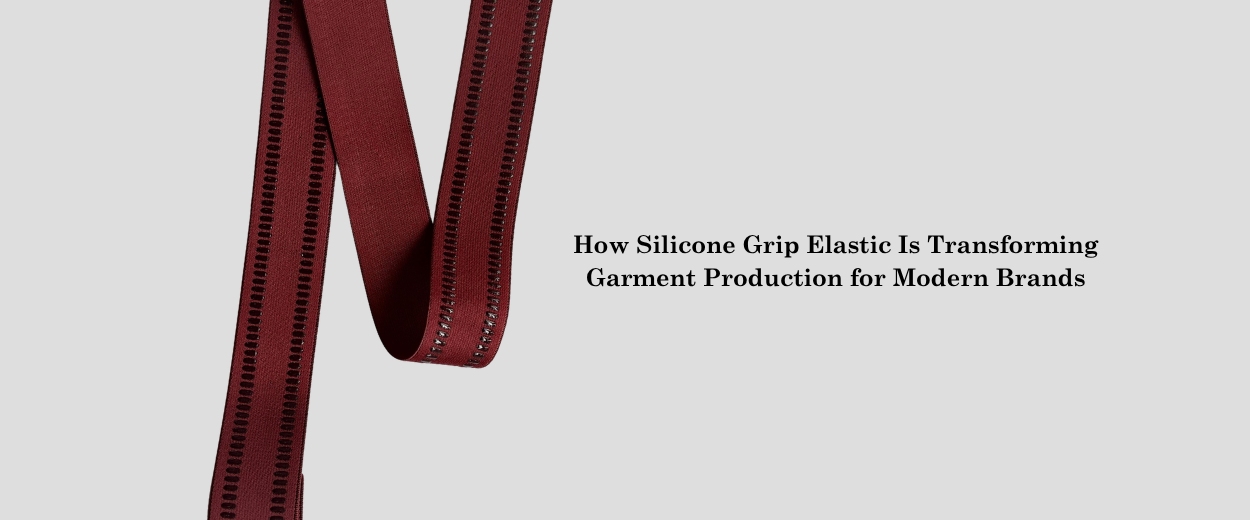
Jacquard elastics are narrow woven or knitted elastic bands in which the pattern, logo, or text is formed during the weaving process itself. A jacquard mechanism controls individual warp yarns independently, raising or lowering each one to create the design structure. The result is a pattern that is physically part of the fabric construction rather than sitting on its surface.
This is the fundamental difference between jacquard and every printed alternative. Screen printing, heat transfer printing, and digital sublimation printing all place the design on top of a pre-constructed elastic substrate. The elastic body exists first; the design is applied second. With jacquard construction, the design and the elastic body are built simultaneously. They are the same object.
There are two primary construction types used for innerwear applications:
Woven jacquard elastic is produced on shuttle or needle looms with a jacquard attachment. The construction is tighter and more structured, producing a firmer hand feel with a more pronounced pattern definition. Logo text and geometric repeats render with higher clarity. Woven construction is the standard choice for premium men’s underwear waistbands where a structured, stable band is the goal.
Knitted jacquard elastic is produced on circular or flat knitting machines with jacquard programming. The construction is softer and more flexible, with a higher stretch ratio and a more textile-like drape. Knitted jacquard is used frequently in lingerie waistbands, fold-over applications, and any category where softness and flexibility take priority over structural firmness.
The choice between woven and knitted construction is a product development decision that should be made at the brief stage, since it affects the yarn specification, the loom setup, and the range of achievable pattern complexity.
The Role of Yarn Construction in Pattern Quality
The yarns used in jacquard elastic production directly determine the visual outcome of the finished waistband. Two elastics can carry the same logo at the same width with the same colour references and produce substantially different results depending on yarn specification.
Ground yarns form the base of the elastic and determine its dominant colour and hand feel. In premium underwear elastic construction, nylon ground yarns produce a softer surface with a natural sheen. Polyester ground yarns produce a more matte finish with slightly higher rigidity. The choice affects both how the logo reads visually and how the band feels against skin during wear.
Effect yarns form the pattern itself. These are the yarns that are raised or lowered by the jacquard mechanism to create the design. Finer denier effect yarns produce sharper pattern edges and cleaner logo definition. Heavier denier yarns produce a more raised, three-dimensional effect that is tactile as well as visual.
Metallic effect yarns are used in some premium lingerie applications to add reflective elements to the jacquard pattern. These require specific handling during weaving and dyeing and are typically a late-stage development decision once the base construction is finalised.
The spandex core runs through the construction independently of the surface yarns and is fully encased by them in the finished elastic. The spandex denier and content percentage determine recovery force and stretch ratio. For standard innerwear waistbands, spandex content of 20% to 35% covers the range from soft-recovery lingerie applications to firm-recovery sport boxer applications.
Specifying yarn composition at the brief stage rather than leaving it to the manufacturer’s default produces more predictable development outcomes and fewer revision rounds on hand feel and visual quality.
Jacquard Elastics vs. Printed Elastic Waistbands: A Direct Comparison
This is the comparison most buyers need to make before committing to a development programme. The differences are technical, commercial, and practical.
| Factor | Jacquard Elastic | Printed Elastic Waistband |
| Design durability | Pattern is structural; survives repeated washing without degradation | Surface print degrades with washing; colour and definition reduce over time |
| Pattern complexity | Best suited to logos, wordmarks, geometric repeats; limited colour count per warp setup | Can achieve photographic complexity and unlimited colour gradients |
| Hand feel | Textured; the pattern is tactile and three-dimensional | Smooth substrate; printed surface adds no texture |
| Colour fastness | High; yarn is piece-dyed or solution-dyed before weaving | Dependent on print process; sublimation offers good fastness, screen printing less so |
| Development time | Longer initial setup (loom programming, colour sampling, pattern trialling) | Faster for first samples; artwork is applied to stock elastic |
| Unit cost at volume | Competitive at mid-to-high volumes once loom setup is amortised | Lower cost at low volumes; scales less favourably than jacquard at high volume |
| Brand positioning | Signals premium construction; visible at point of sale and in use | Appropriate for mid-market; premium positioning harder to sustain as print ages |
The most important row in this table for a brand building long-term product equity is durability. A printed elastic waistband that looks sharp at launch will look noticeably different after fifteen washes. A jacquard waistband will look the same. For a brand whose garment is expected to last two or three years of regular use, that difference shows up in repeat purchase behaviour and in the consumer perception of quality.
Material Composition in Jacquard Elastics for Underwear
The materials used in jacquard elastic construction affect stretch ratio, recovery, hand feel, wash performance, and colour rendering. Buyers sourcing custom elastic band for underwear waistbands should understand the standard options before briefing a manufacturer.
Nylon (polyamide) is the premium choice for underwear applications. Nylon accepts dye more readily than polyester, which results in richer, deeper colours and more accurate Pantone matching. The hand feel of nylon jacquard is softer and more skin-friendly, which matters on a band worn directly against the body. Nylon also has a natural sheen that contributes to the premium visual appearance of the waistband. The trade-off is cost; nylon yarn is more expensive than polyester.
Polyester is widely used where cost efficiency is the primary driver. Polyester jacquard elastics are more resistant to moisture and UV degradation, which makes them appropriate for activewear and swimwear applications where repeated exposure to water and sunlight is expected. Colour rendering is adequate but generally lacks the depth and saturation achievable with nylon.
Cotton content is sometimes added to jacquard elastic constructions for innerwear intended to prioritise skin comfort. Cotton blends soften the hand feel of the band significantly. The trade-off is wash performance; high cotton content elastics are more prone to shrinkage and slower to dry, which affects garment finishing processes.
Spandex (Lycra/elastane) core is the element that provides elasticity in all jacquard constructions. The spandex filaments run through the elastic substrate and are covered by the ground yarns during weaving. The spandex content and denier determine the stretch ratio and the recovery force of the finished elastic. Higher spandex content produces stronger recovery and a firmer feel on the body. Lower spandex content produces softer recovery and a lighter wearing experience.
Rubber core is used in some constructions as an alternative to spandex, typically in wider waistbands where high recovery force is a functional requirement. Rubber core construction is less common in premium innerwear since the hand feel is stiffer and the environmental profile of natural rubber is less favourable than synthetic spandex.
For premium underwear elastic intended for direct skin contact, nylon-face jacquard with a spandex core is the standard specification. Polyester is acceptable for mid-market innerwear and for applications where moisture performance takes priority.
Standard Widths and Specifications for Innerwear Waistbands
Jacquard elastics for innerwear are produced in a range of widths. The standard widths in the men’s and women’s innerwear categories are:
25mm (1 inch): Used in lightweight briefs, women’s underwear, and thinner profile products. The narrower width limits pattern complexity since there is less weaving space available for repeat design.
32mm (1.25 inch): The most common width for mid-range men’s briefs and trunks. Sufficient width for a single-line wordmark or logo with a ground colour.
38mm (1.5 inch): The standard premium width for men’s boxers, trunks, and branded innerwear lines. Allows for more complex pattern repeats, two-colour designs, and cleaner logo rendering.
50mm (2 inch) and above: Used in sport boxers, performance underwear, and waistbands designed to be partially visible above trouser waistlines. At this width, more elaborate jacquard patterns become achievable, including full brand identity programmes with taglines or secondary graphic elements.
Width selection affects the loom setup, the amount of design area available for branding, and the sewn appearance of the finished garment. Brands building a consistent product range across multiple SKUs typically standardise on one or two widths to reduce sampling rounds and simplify bulk ordering.
Single-Sided vs. Double-Sided Jacquard Construction
Jacquard elastics for innerwear are produced in single-sided and double-sided constructions. Understanding the difference matters for brands where the inside of the waistband is visible or where the band is worn in a fold-over configuration.
Single-sided jacquard produces the pattern on the face of the elastic only. The reverse side shows the technical construction of the weave, typically a plain or ribbed ground with visible floats from the pattern yarns. For standard sewn-in waistband applications where the reverse sits against the body or is enclosed within the garment, single-sided construction is the standard specification and the more cost-efficient choice.
Double-sided jacquard produces a clean, finished appearance on both faces of the elastic. The reverse side carries either a mirror of the face pattern or an independent design. Double-sided construction is used for fold-over waistbands where both faces are visible in the finished garment, for exposed waistband applications on lounge and sleep products, and for any product where the inside label area will be visible at point of sale. Double-sided construction requires more complex loom programming and higher yarn consumption, which is reflected in the unit cost.
Brands developing a waistband programme across multiple product types within a range sometimes use single-sided construction for core innerwear and double-sided for premium or gifting lines within the same brand identity.
The Custom Jacquard Elastic Development Process
The development of a custom jacquard elastic waistband follows a structured sequence. Understanding each stage helps brands plan their sampling timelines and avoid delays from incomplete briefing.
Stage 1: Technical brief. The manufacturer needs the finished width of the elastic in the garment (accounting for any fold-over or tuck construction), the colour references (Pantone numbers against the intended yarn substrate), the artwork file in vector format, and the performance requirements (stretch ratio, recovery force, shrinkage tolerance).
Stage 2: Yarn selection and loom programming. The manufacturer identifies the appropriate yarn specifications and programs the jacquard loom to execute the pattern repeat. At this stage, any constraints on pattern complexity from the loom equipment will be identified. Designs with high colour counts or very fine detail may require simplification for weaving.
Stage 3: First colour samples. Yarn samples are dyed to the reference colours and presented for approval before weaving begins. This stage is critical for nylon constructions, where colour rendering on the elastic substrate under stretch will differ from a flat dye swatch. Manufacturers without in-house dyeing capability present samples from external dye houses, which extends this stage by several days per iteration.
Stage 4: First woven sample. A sample length of the elastic is woven and presented for assessment of pattern definition, colour registration, hand feel, and stretch properties. This is typically where most revision rounds occur.
Stage 5: Bulk approval sample. Once the development sample is approved, a bulk approval sample is produced from the materials and loom settings that will be used in production. This sample is the benchmark against which bulk production quality is measured.
The total development timeline from brief to bulk approval ranges from four to eight weeks depending on the complexity of the design and the manufacturer’s in-house versus outsourced dyeing capability.
Why Sourcing Jacquard Elastics from India Makes Sense
India is among the world’s principal manufacturing locations for narrow elastic fabrics, with Surat in Gujarat operating as a concentrated production hub for elastic, webbing, and narrow woven trims. The manufacturing infrastructure in Surat supports the full vertical of textile production, from yarn processing and dyeing through to narrow fabric weaving and finishing.
For international buyers, sourcing custom jacquard elastic from Indian manufacturers offers a combination of technical capability, competitive pricing, and supply chain flexibility that Chinese alternatives often cannot match on responsiveness and minimum order terms. For domestic Indian innerwear brands, proximity to Surat-based manufacturers reduces lead times significantly and supports the kind of iterative development process that custom jacquard programmes require.
The density of textile expertise in Surat also means that buyers working with Surat-based manufacturers benefit from access to a deep pool of technical knowledge specific to elastic and narrow fabric manufacturing.
Certifications and Compliance Considerations for Export Markets
Innerwear brands sourcing jacquard elastics for export markets face increasingly specific compliance requirements that affect both material specification and manufacturer selection.
OEKO-TEX Standard 100 certification covers testing of textile products for harmful substances. For innerwear specifically, which falls into Product Class I (direct skin contact), the threshold requirements are stricter than for outerwear or accessories. Brands supplying to European or US retail chains frequently require OEKO-TEX certification on all trims including elastic. Buyers should confirm whether the manufacturer holds current certification or whether individual dye lots can be tested to the standard on request.
REACH compliance applies to chemical substances used in textile manufacturing and is a mandatory requirement for export to the European Union. Relevant to elastic manufacturing specifically are restrictions on certain azo dyes used in yarn dyeing and residual chemical finishes applied post-weaving. Buyers sourcing for EU markets should request REACH compliance documentation as part of the supplier qualification process.
BCI (Better Cotton Initiative) and GOTS (Global Organic Textile Standard) certification are relevant for brands positioning on sustainability. GOTS certification requires that all inputs in the supply chain meet organic standards, which affects yarn sourcing upstream of elastic production. Brands with active sustainability programmes should discuss certification status with manufacturers early in the supplier evaluation process since adding certification requirements after development has started substantially complicates the supply chain.
For domestic Indian innerwear brands, compliance requirements are currently less stringent than for export markets, but brands building toward export expansion benefit from establishing compliant supply chains from the start of their product programme rather than retrofitting compliance requirements onto an existing supplier base.
Konika Elastics: Custom Jacquard Elastic Manufacturer in Surat
Konika Elastics manufactures jacquard elastics for innerwear brands across domestic and export markets from its manufacturing facility in Surat. Three aspects of Konika’s production capability are particularly relevant for brands evaluating custom waistband suppliers.
In-house nylon yarn dyeing. Konika dyes nylon yarns internally. Colour development for custom jacquard programmes is managed entirely within the facility, without handoffs to external dye houses. The practical consequence for buyers is faster colour approval cycles and higher consistency between approved samples and bulk production. Colour deviations that require two or three rounds of correction through an external dye house are typically resolved within a single internal iteration.
Pre-shrunk elastic construction. Konika’s elastics are pre-shrunk during manufacturing to approximately 1% residual shrinkage. Standard elastic constructions in the industry typically carry residual shrinkage of 3% to 5%. For innerwear brands processing garments through finishing operations at elevated temperatures, the difference between 1% and 4% shrinkage in the waistband translates directly into waistband puckering, garment rework rates, and quality hold costs in finished goods.
ERP-based production tracking. Order status, material allocation, and production progress are tracked through an integrated ERP system. For buyers managing multiple waistband SKUs or seasonal colour programmes, this provides structured visibility into order progress without requiring manual follow-up communication. It also supports quality traceability requirements for brands whose retail partners or export market certifications require documented production records.
Konika manufactures both woven and knitted jacquard constructions across standard innerwear widths, from 25mm through 50mm. Development programmes for custom waistbands begin with a technical brief and initial colour consultation with the production team.
Frequently Asked Questions on Jacquard Elastics for Innerwear
What is the difference between woven and knitted jacquard elastic?
Woven jacquard elastic is produced on shuttle or needle looms and has a firmer, more structured construction with higher pattern definition. Knitted jacquard elastic is produced on knitting machines and has a softer, more flexible construction with a higher stretch ratio. For premium men’s underwear waistbands, woven construction is the standard. For lingerie and fold-over applications, knitted construction is more common. The choice affects yarn specification, loom setup, achievable pattern complexity, and hand feel in the finished garment.
What is the minimum order quantity for custom jacquard elastic?
Minimum order quantities for custom jacquard programmes typically range from 500 metres to 2,000 metres per colour and width. The loom setup for a custom design represents a fixed cost that must be spread across the production run. Brands with lower volume requirements should discuss development order terms with the manufacturer, since some manufacturers accommodate smaller initial runs at adjusted unit pricing for brands in early scaling stages.
How many colours can a jacquard elastic design use?
Woven jacquard construction typically supports two to six colours depending on loom capacity and the number of warp positions available. For most innerwear waistband applications, two to three colours are sufficient to render a brand logo clearly and at an achievable cost. Designs requiring a higher colour count or photographic complexity are better suited to sublimation printing than jacquard weaving.
Does jacquard construction affect the stretch ratio of the elastic?
Yes, slightly. The pattern weave structure in jacquard construction introduces additional interlacing between yarns compared to a plain construction, which produces a marginally lower stretch ratio at the same spandex content. For most innerwear waistband applications, this difference falls within acceptable tolerance. Buyers with specific stretch ratio requirements should include those parameters in the technical brief so the manufacturer can adjust spandex content accordingly.
What causes colour variation between development samples and bulk production?
The most common cause is a change in the dyeing process between sample and bulk, particularly when sample dyeing is handled by a different facility or at a different batch size than bulk production. Elastic substrates under stretch behave differently from flat fabric at the dye bath stage, which means colours that appear accurate on a flat sample can shift when the elastic is stretched to its working width. Manufacturers with in-house dyeing capability and documented colour standards between sample and bulk approvals produce more consistent outcomes than those relying on external dye houses.
What wash care is required for jacquard elastic waistbands?
Because the design is structural and part of the fabric construction, jacquard elastics tolerate standard machine washing without the surface degradation that affects printed alternatives. Wash temperatures above 60°C accelerate spandex breakdown over time regardless of construction type. For premium innerwear, cool or warm wash at 30°C to 40°C is the standard care instruction for maintaining long-term waistband performance and elasticity recovery.
How long does custom jacquard waistband development take?
A typical development programme runs four to six weeks from technical brief to approved bulk sample. Programmes with complex colour matching, multiple design iterations, or certification requirements may extend to eight weeks. Brands building seasonal product programmes should factor development lead time into the product calendar from the design phase rather than treating it as a parallel workstream to garment sampling.
Can the same jacquard design be adapted across different elastic widths?
Yes, but the pattern scale and repeat must be adjusted for each width. A design developed for a 38mm waistband requires rework to run accurately on a 50mm or 25mm band. The standard approach for brands building a multi-width programme is to develop the design at the widest specification first and adapt downward, since reducing scale is technically more straightforward than enlarging it. Each width variant requires its own loom setup and approval sample.
What information does a manufacturer need to start custom development?
A complete development brief includes: finished garment width and construction method (exposed, folded, or sewn-in); Pantone colour references specified against the intended yarn substrate (nylon or polyester); vector artwork at the correct repeat width; target stretch ratio and recovery force if specified; wash care requirements; and any certification requirements applicable to the end market. Manufacturers who receive complete briefs at the start of development consistently produce better first samples and run fewer approval rounds than those working from incomplete specifications.
Working with a Jacquard Elastic Manufacturer: Getting the Brief Right
The development outcomes from a custom jacquard elastic programme are directly proportional to the quality of the initial brief. Manufacturers who receive complete technical information at the start of development can identify potential issues at the specification stage rather than after the first sample. That shift from reactive to proactive problem-solving reduces total sampling rounds and compresses the overall development timeline.
A complete brief for a custom jacquard elastic waistband includes: the finished garment width and whether the elastic will be exposed or sewn inside a waistband; Pantone references against nylon or polyester substrate as appropriate; vector artwork at the correct repeat width; target stretch ratio and recovery force if specified; wash care requirements; and any certification requirements (OEKO-TEX, GOTS, or equivalent) applicable to the end market.
Brands that approach elastic development with this level of specificity consistently achieve faster approval cycles and fewer quality surprises in bulk production.
Konika Elastics works with innerwear brands at the development stage for custom jacquard waistband programmes. For technical enquiries and development briefs, contact the production team directly.