A garment buyer at a mid-size innerwear brand once described the elastic waistband as “the last thing we specify and the first thing that fails in the market.” It is an accurate summary of how waistband elastic gets treated in the product development process. Width and colour get decided quickly. Construction type is often whatever the previous supplier sent. Pre-shrinkage is assumed rather than confirmed. By the time the first customer return lands, the decision that caused it was made six months earlier in development, usually in under ten minutes.
The waistband on a pair of underwear is small by area. By performance demand, it is one of the most tested components in a finished garment. It stretches on every wear, recovers on every removal, sits against bare skin for hours, and is expected to hold the same fit through wash cycle after wash cycle. When it degrades, the garment degrades. The fabric can be perfect. The cut can be perfect. A waistband that frills, narrows, or loses tension makes the whole product feel cheap.
This is the production reality that separates serious underwear elastic manufacturers from those supplying a commodity product.
What Underwear Elastic Manufacturers Are Actually Engineering
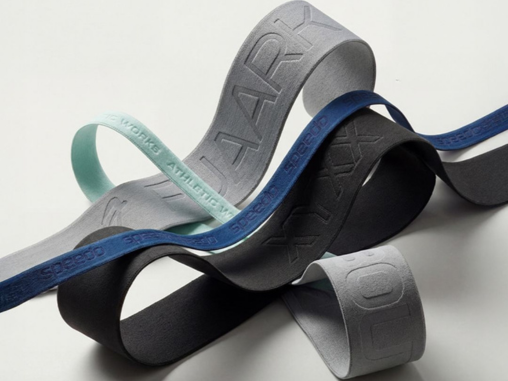
Every elastic waistband for underwear has to satisfy three performance demands simultaneously: it must stretch enough to pull on comfortably, recover fully to hold its position, and survive the mechanical stress of repeated wear and washing without narrowing, frilling, or losing tension.
These three demands pull in different directions at the construction level. Higher elasticity often comes at the cost of recovery speed. Softer surface finishes can reduce durability. Aggressive dyes that hold colour through washing can affect hand feel. The engineering of an elastic waistband is the process of managing these trade-offs, and each underwear segment has a different balance point.
Yarn selection is the first decision. The core of an elastic waistband is rubber or spandex, wrapped or covered with nylon or polyester. The covering yarn determines hand feel, dyeability, surface texture, and how the elastic behaves when sewn. Nylon covering gives a softer, more luxurious feel against skin. Polyester covering increases abrasion resistance and holds colour differently. For innerwear that sits directly against the body, nylon is typically the preferred covering material because of its skin-comfort properties.
Construction method determines the character of the elastic. Plain woven elastic gives a firm, structured waistband with minimal stretch variation across the width. Knitted elastic is softer and more conforming, with a slightly cushioned feel. Jacquard elastic waistbands add a structural pattern into the weave itself, which allows branding, texture, or design detail without a secondary printing process.
The width matters for fit. For men’s underwear, waistband widths typically run between 25mm and 38mm (1.0″ to 1.5″). Women’s underwear waistbands are narrower, typically 13mm to 25mm (0.5″ to 1.0″). These width ranges are established by garment construction conventions and affect how the elastic distributes pressure against the body. A waistband that is too narrow concentrates pressure. One that is too wide can fold during wear if the elastic recovery force is insufficient.
Elongation and recovery are measured, not assumed. In lab testing, elongation refers to how far an elastic can stretch before it reaches its limit. Recovery measures how completely it returns to original dimensions after being held at extension. Both are tested against production specifications before a batch is approved. An elastic waistband for underwear with poor recovery will stretch out gradually over wash cycles and begin to feel loose even when the garment fit is otherwise correct. This is one of the most common quality failures in the category.
Woven, Knitted, or Jacquard: Choosing the Right Elastic Waistband Construction
The construction method is the single decision that most shapes how a finished waistband performs. It affects skin feel, stretch character, visual appearance, and how the elastic behaves under sewing tension. Buyers who specify width and colour without locking the construction first will get a waistband that may be technically correct and still wrong for the application.
Plain woven elastic produces a firm, structured waistband with a flat surface and defined edges. The weave structure resists rolling and holds its width well under repeated stretching. For men’s underwear where the waistband is visible above the trouser line and needs to maintain a clean, flat appearance throughout the day, woven elastic gives the most consistent result. The trade-off is that woven elastic has a firmer feel against skin compared to knitted alternatives. It suits applications where structure is prioritised over softness.
Knitted elastic is softer and more conforming. The looped construction gives it a cushioned feel at the contact surface and a stretch character that moves more naturally with the body. For women’s underwear, for children’s innerwear, or for any category where all-day skin comfort is the primary requirement, knitted construction typically outperforms woven on comfort measures. Knitted elastic also responds better to body movement during physical activity because the entire structure flexes rather than resisting. The consideration is that knitted elastic requires tighter QC on shrinkage, as the looped structure can tighten more significantly if the pre-shrinking step is skipped or inconsistent.
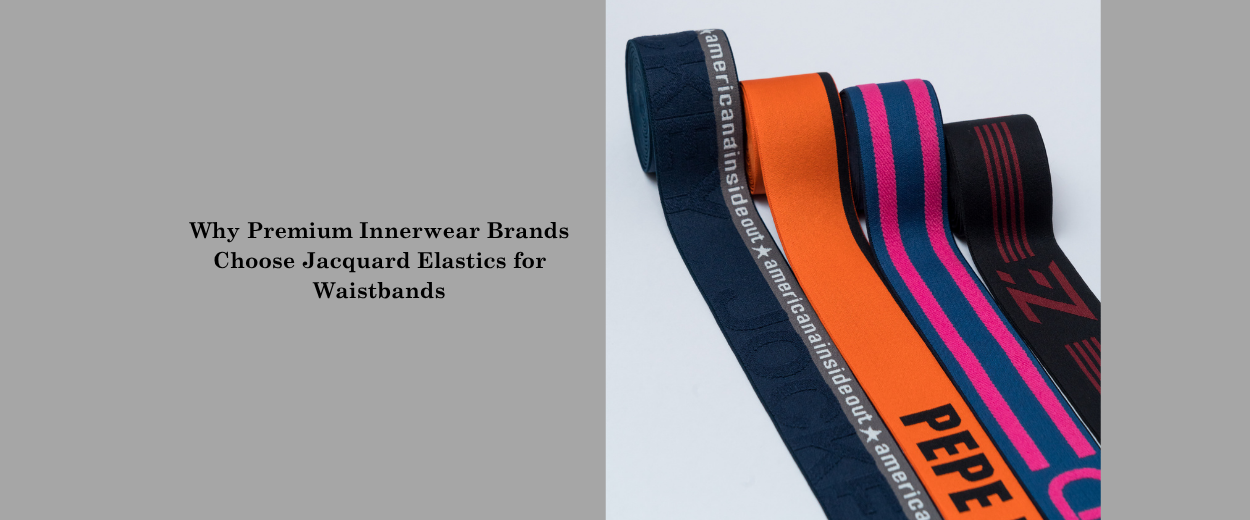
Jacquard elastic waistbands add a pattern, logo, or design into the construction itself. The jacquard loom programmes the pattern into the weave, so the design is structural rather than applied. This matters in innerwear because applied prints and embossed finishes degrade with washing. A woven jacquard pattern does not. For premium innerwear brands where the waistband is a branding surface, the jacquard waistband is the only construction that holds brand integrity through the wash life of the product. Jacquard elastics are available for both men’s and women’s innerwear, with width customisation and the option of dope-dyed yarns for enhanced colour fastness.
The choice between these three constructions should be made in development, with a physical sample of each in the required width and colour, before any pattern is cut. A decision made against a sample is reversible. A decision made against a spec sheet alone is not.
The Shrinkage Problem Most Buyers Discover Too Late
Shrinkage in elastic waistbands is a separate problem from shrinkage in the garment fabric, and it is frequently overlooked until the garment is in production or, worse, in the market.
When an elastic shrinks during its first few washes, two things happen. The waistband length reduces, which distorts the garment silhouette and makes the underwear tighter at the waist. The width of the elastic can also reduce, which changes how it sits on the body and affects the sewing line. For a garment that is cut and sewn to precise measurements, even a few millimetres of elastic shrinkage at scale will produce a high rate of fit complaints.
The industry standard for elastic shrinkage runs between 5% and 8% over the first few wash cycles. This is accepted as normal, and garment patterns are often adjusted to compensate. The adjustment works only if the shrinkage is consistent. Variable shrinkage from batch to batch makes pattern adjustment ineffective because the compensation built into the pattern applies to an average that may never match any individual batch.
Pre-shrinking the elastic before dispatch addresses this at the source. When elastic for underwear is pre-shrunk in the manufacturing process, the residual shrinkage on the finished garment drops significantly. The garment manufacturer is working with an elastic that has already undergone most of its dimensional change, and the fit produced in sampling holds much more reliably through production and washing.
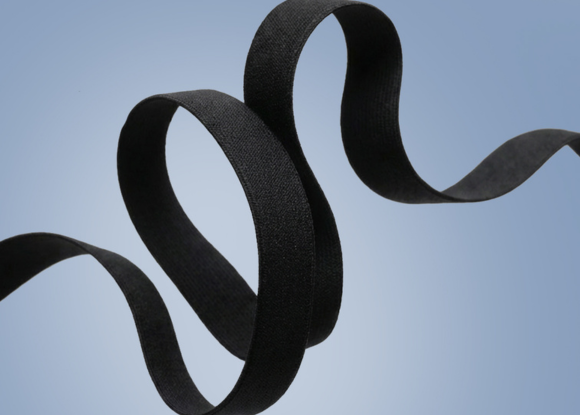
Elastics produced by Konika are pre-shrunk. Residual shrinkage is approximately 1%, compared to the 5-8% typical of standard elastic in the market. For garment manufacturers, this means patterns cut in development produce the same fit in bulk production, and that fit holds through wash cycles as the customer uses the garment.
How Underwear Elastic Manufacturers in India Approach Custom Waistband Development
The ability to customise an elastic waistband for underwear is one of the clearest differentiators between manufacturers who operate as commodity suppliers and those who function as product development partners.
A custom elastic waistband typically starts with three inputs from the buyer: width, construction preference, and colour. Width and construction are usually established in the first round of sampling. Colour is where most of the development time sits, particularly for brands that require DTM (dye to match) colours that align precisely with the fabric of the garment.
DTM colour matching on elastic is harder than it looks. Elastic is constructed from a mix of materials. Nylon, polyester, rubber, and spandex all take dye differently. A colour that looks accurate on nylon yarn can shift on the finished elastic tape because the light hits the structured surface differently. Manufacturers without in-house dyeing capability send work to external dye houses, which means sampling cycles run in days or weeks rather than hours. The brand waits. Development timelines extend. Launch windows shrink.
Underwear elastic manufacturers in India with in-house dyeing facilities can turn colour samples faster because they control the dyeing process directly. At Konika, the dyeing facility is the largest narrow fabric dyeing operation in India. It handles knitted and woven elastics with precision dye control optimised specifically for elastic substrates. This is a different process from dyeing fabric or garment yarn. Elastic dyeing requires managing the tension state of the tape during dyeing to prevent dimensional change, and controlling dye uptake across mixed-fibre constructions.
The result is colour samples returned in 2 to 3 days rather than the week or more that external dye house routing typically requires. For brands running seasonal development calendars, this difference in sampling speed changes what is possible within a development window.
Custom elastic waistband orders are available across Konika’s product range. This includes plain woven elastics in widths from 0.25″ to 10″, knitted elastics from 0.25″ to 12″, and jacquard elastics customised for both men’s and women’s innerwear. Width, material composition, surface texture, and colour are all configurable based on buyer requirements.
Jacquard Elastic Waistbands: Where Construction Becomes Brand Expression
A plain elastic waistband does one job. A jacquard elastic waistband does two. It performs as an elastic and carries brand identity in the structure of the tape itself.
In a jacquard loom, the pattern is woven into the elastic rather than printed or embossed on its surface. This means the pattern does not fade, crack, or peel. Washing does not degrade the logo or design because the design is the construction. For brands where the waistband is visible above the trouser line, the jacquard waistband is the primary branding surface on the garment.
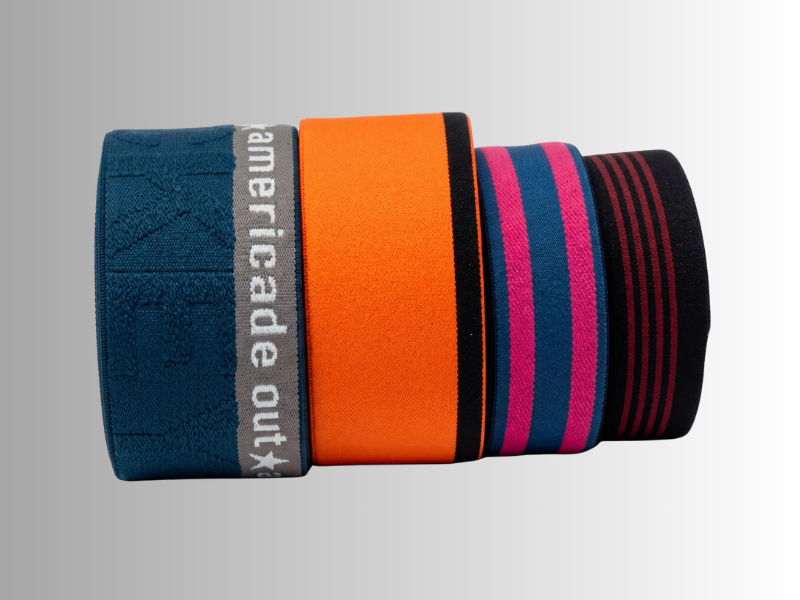
A jacquard elastic waistband can carry a brand logo, a repeating text pattern, a geometric motif, or a combination of these elements. The width available for the pattern is determined by the waistband width. At standard innerwear widths of 25mm to 38mm for men’s products, there is enough real estate for clear logo presentation. Women’s waistbands at 13mm to 25mm allow a simpler pattern or text repeat.
Dope-dyed yarns are available as an option for jacquard elastic waistbands. In dope-dyed yarn, the pigment is introduced at the fibre production stage rather than applied to the finished yarn or tape. The result is colour that is consistent throughout the fibre cross-section. Colour fastness in wash, sublimation, and light exposure is higher with dope-dyed construction than with surface-dyed or yarn-dyed alternatives. For premium products where colour consistency and wash performance are non-negotiable, dope-dyed jacquard is the specification to request.
Konika produces jacquard elastics specifically for underwear, boxers, and sports innerwear, using dyed and dope-dyed yarns, customisable in widths and materials. The facility is Oeko-Tex and GRS certified, which matters for brands sourcing for markets that require material compliance documentation.
The Role of In-House Testing in Elastic Waistband Quality
A waistband that performs correctly in sampling and fails in production is a familiar problem in garment manufacturing. The gap between sample and bulk usually comes from one of two places: inconsistent incoming material or process variation that is not caught before dispatch.
Serious underwear elastic manufacturers run testing at multiple stages, with the same tests applied to bulk production that were used to approve the development sample. The parameters that matter for an elastic waistband for underwear are: shrinkage, elongation, modulus (the force required to stretch to a given extension), colour fastness to washing, colour fastness to sublimation, and flexing resistance.
Flexing resistance measures how the elastic behaves under repeated bending stress. An elastic that degrades quickly under flexing will begin to narrow and corrugate at the fold line. In underwear, this appears as the waistband starting to frill or curl at the edges after washing. It is a quality failure that buyers will attribute to the garment, even though it originates in the elastic specification.
At Konika, every sample dispatched to a customer goes through full lab testing before it leaves the facility. This covers physical specifications, elongation, modulus, shrinkage, colour fastness to washing and sublimation, and flexing. The lab operates across all three entities within the Konika Group, with in-house testing infrastructure at each production unit.
The purpose of testing every sample, rather than batch-testing production, is that the sample is the buyer’s reference point. If the sample passes internal testing and the buyer’s own QC, the buyer approves it for bulk production with confidence that the specification is locked. Production batches are then tested against that locked specification.
What Konika Supplies to Underwear Manufacturers
Konika operates three entities, each covering a distinct segment of the innerwear elastic category.
Konika Intima Pvt. Ltd. was established in 2012 and specialises in lingerie and women’s innerwear elastics. This includes waistband elastics, picot elastics, bra straps, wire casing, foldover elastics, and knitted elastics. The facility has a dedicated product development area and produces 20 million metres per month. It holds Oeko-Tex and GRS certification.
Konika Tapes Pvt. Ltd. was established in 2021 and focuses on engineered elastics for men’s innerwear and performance categories. Products include jacquard elastics for men’s underwear and boxers, sports bra straps and underbands, neck tapes, and branded folding tapes. Capacity is 2.4 million metres per month. It also holds Oeko-Tex and GRS certification.
Konika Elastics Pvt. Ltd. is the original entity, established in 1996, and produces across a wider range including sportswear, men’s and women’s apparel, and specialised categories. It manufactures both white and coloured elastic tapes with full customisation capability and produces 20 million metres per month. It holds GRS certification.
Across all three entities, Konika supplies elastic waistbands to garment manufacturers. The supply includes standard product from stock as well as custom development. Clients include Jockey, Van Heusen Innerwear, Rupa, Lux, XYXX, DaMENSCH, Zivame, and Technosport, among others.
The group has 25 years of manufacturing experience, serves over 1,500 clients, and has a combined production capacity exceeding 40 million metres per month.
For garment manufacturers sourcing elastic for underwear, the evaluation question is whether the supplier controls the variables that affect the performance of the finished waistband: pre-shrinkage, in-house dyeing for accurate colour, in-house testing at both sample and production stages, and the technical depth to specify yarn and construction correctly for the underwear segment. These are the factors that determine whether the elastic performs in the garment as it performed in the sample.
The Specification Decisions That Separate Good Waistbands From Failed Ones
Buyers sourcing a custom elastic waistband often arrive with a width requirement and a colour swatch. The specification conversation needs to go further than that.
Covering yarn choice affects skin feel more than any other variable. Nylon covering is softer against skin. Polyester covering is harder-wearing. For underwear that sits against the body, the covering yarn on the top face of the elastic is what the wearer contacts. This choice should be made explicitly, with a sample, before bulk approval.
Construction choice determines how the waistband moves with the body. Woven elastics are firmer and more structured. Knitted elastics conform more easily to body movement. For underwear worn during physical activity, knitted construction typically gives a more comfortable fit because the elastic moves with the body rather than against it. For premium underwear where the waistband needs to hold its shape visually, woven construction gives a cleaner edge.
Colour specification needs to account for the full wash cycle, not just initial appearance. An elastic that looks correct against the garment fabric in the first wash can shift by cycle twenty because the dye chemistry on elastic substrates behaves differently from garment fabric dye. This is why colour fastness testing to washing is a standard lab parameter for elastic waistbands, and why it should be requested by the buyer as part of the sample approval package.
Pre-shrunk specification should be stated, not assumed. Most elastic in the market is supplied without pre-shrinkage treatment. If the buyer’s pattern is cut to compensate for 5-8% shrinkage and the elastic supplied is pre-shrunk to 1% residual, the finished garment will measure differently than the pattern intends. The specification should match the construction of the garment, and the garment developer should know which they are working with from the first sample.
These decisions are made in development. They cannot be corrected in production. The role of an experienced elastic manufacturer is to raise these questions before sampling begins, produce samples that lock the specification clearly, and then hold that specification consistently through bulk production.
Sourcing Elastic Waistbands for Underwear: What to Request
When approaching underwear elastic manufacturers for a new development, the following specifications will determine whether the first sample round produces usable results or requires multiple correction cycles.
State the waistband width clearly in millimetres, the end use (men’s, women’s, children’s), the construction preference if known (woven, knitted, or jacquard), the colour requirement including any DTM fabric swatch, the surface finish preference (matte, sheen, soft touch), and any certification requirements that apply to the destination market (Oeko-Tex, GRS, REACH).
Ask explicitly whether the elastic is pre-shrunk, what the residual shrinkage figure is, and request lab test data for the sample covering at minimum shrinkage, elongation, modulus, and colour fastness to washing.
For jacquard elastic waistbands, provide artwork in a vector format and specify the colour count. Ask whether dope-dyed yarns are available for the colours required, particularly if the end product is in a premium segment where colour consistency and wash performance carry a warranty expectation.
For custom programmes at scale, ask whether the manufacturer can handle the annual volume required within standard lead times without subcontracting the dyeing or the weaving. Subcontracting either introduces a variable that the primary supplier cannot fully control.
These questions distinguish sourcing conversations that move efficiently from those that stall at every development round. The answers reveal quickly whether the supplier has the infrastructure to deliver the specification consistently, or is offering a product that will look right in the first sample and drift in production.
Konika is a narrow fabric manufacturer based in Surat, Gujarat, supplying elastic waistbands to underwear manufacturers across India and internationally. For sampling or production enquiries, contact the Konika team through konikaelastics.com.
Common Questions Buyers Ask When Sourcing Elastic for Underwear
What width elastic is used for underwear waistbands?
For men’s underwear, waistband widths most commonly fall between 25mm and 38mm (1.0″ to 1.5″). Women’s underwear waistbands typically run narrower, between 13mm and 25mm (0.5″ to 1.0″). These ranges reflect standard garment construction for the category. Wider waistbands above 38mm are used in specific applications such as shapewear or compression underwear where higher coverage and support are required. The correct width depends on the garment construction, the desired visual weight of the waistband, and the sewing method (whether the elastic is enclosed in a casing or top-stitched directly to the fabric).
What is the difference between knitted and woven elastic for underwear?
Knitted elastic is softer and more conforming against skin. It suits categories where all-day comfort is the primary requirement. Woven elastic is firmer and holds its structure better under repeated wear. It suits applications where the waistband needs to stay flat and maintain a clean visual appearance. Both are available in the width ranges used for underwear. The choice should be made against a physical sample in the required specification, as the difference in hand feel is significant and affects buyer approval at the development stage.
Does elastic shrink after washing?
Standard elastic shrinks between 5% and 8% over the first few wash cycles. This is a dimensional change that affects the fit of the finished garment. Pre-shrunk elastic has been treated in the manufacturing process to reduce residual shrinkage to approximately 1%. For garment manufacturers who need consistent fit from development through bulk production and across the wash life of the product, pre-shrunk elastic eliminates the main variable that causes fit to drift between sampling and production.
What is a jacquard elastic waistband?
A jacquard elastic waistband has a pattern or design woven into its structure during manufacture. The pattern is produced on a jacquard loom, which programmes each thread individually to create the design. Because the design is structural, it does not fade or degrade with washing the way printed or embossed finishes do. Jacquard waistbands are used by innerwear brands as a branded waistband surface, carrying logos, text, or patterns. They are available in custom widths and can be produced in dope-dyed yarns for enhanced colour fastness in premium applications.
What certifications should I ask for when sourcing elastic for underwear?
For innerwear intended for export markets or brands with compliance requirements, the relevant certifications are Oeko-Tex Standard 100 (which confirms the elastic is free from harmful substances) and GRS (Global Recycled Standard, relevant if the specification includes recycled yarn content). Buyers sourcing for the EU or North American markets should confirm both certifications are current and request documentation that covers the specific product being ordered, not a general company certification.
Can elastic waistbands be custom coloured to match garment fabric?
Yes. Custom colour development on elastic waistbands is standard practice in the innerwear industry. The process involves dye matching to a fabric swatch or Pantone reference, followed by a lab dip that the buyer approves before bulk production. The critical factor is whether the elastic manufacturer has in-house dyeing capability. Manufacturers who dye in-house can return colour samples in 2 to 3 days. Those who send work to external dye houses typically take longer, which extends development timelines when multiple colour corrections are needed.