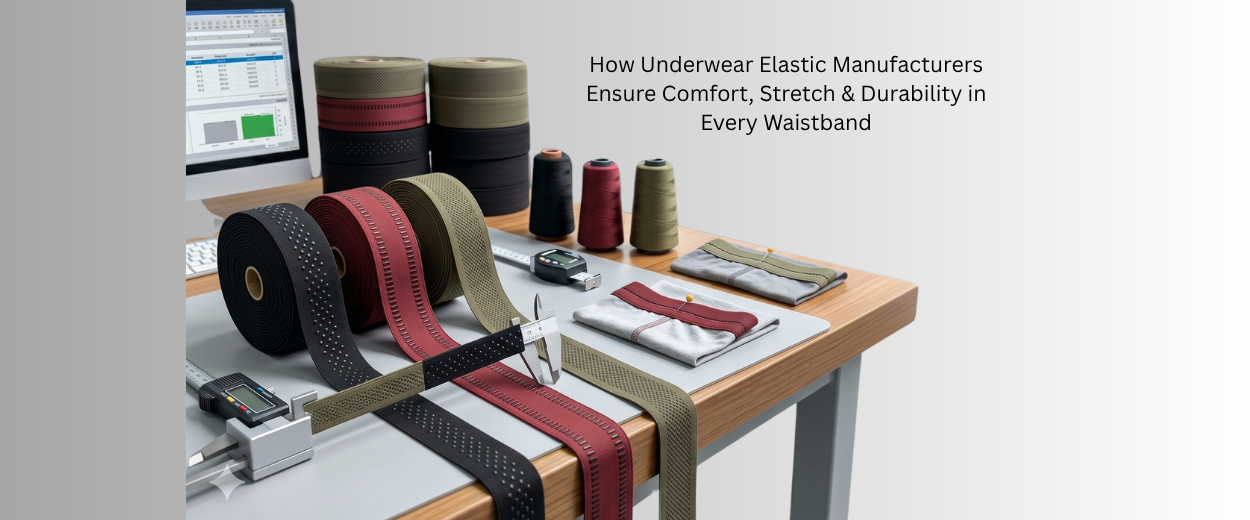
The sample was perfect. Twelve millimetres wide, clean edges, good snap-back, colour matched to the brief. The order went out. Six weeks later, the bras came back from the garment factory with straps running short. The elastic had shrunk in the first wash cycle. Nobody had specified a shrinkage tolerance. The supplier had no reason to test for one.
That sequence plays out regularly in the Indian lingerie supply chain. A buyer approves what they can see and touch. Everything left unspecified defaults to whatever is cheapest for the supplier to produce. The gap between sample performance and bulk performance is almost always found in the specifications nobody wrote down.
Sourcing elastic bra straps wholesale is a materials decision with a long tail. A wrong call shows up in customer returns, garment factory rework costs, and reorders that arrive in a different shade than the first batch. What follows covers the construction types, material choices, and cost drivers that determine how a bra strap elastic actually performs at scale.
The short version: Elastic bra straps are sourced in two primary constructions: woven and knitted, in widths from 10mm to 25mm for standard lingerie and wider for sports bras. Price is driven by yarn composition, whether dyeing is in-house or outsourced, and order volume. The most common quality failures at bulk production: shrinkage, colour drift between batches, and recovery loss. All three are preventable with the right specs in writing before production begins.
Where Elastic Bra Straps Are Made in India: The Surat Supply Chain
Surat is the centre of narrow fabric manufacturing in India. The city accounts for the majority of India’s elastic production across lingerie, sportswear, innerwear, and apparel categories. The concentration of manufacturers in one geography creates a supply chain depth that does not exist elsewhere in the country: yarn texturizers, dye houses, needle loom operators, and finishing units are all within proximity of each other.
For a buyer sourcing elastic for bra making, this matters in practical terms. Lead times from a Surat-based manufacturer to a garment factory in Bengaluru, Chennai, or the NCR run significantly shorter than lead times from import sources. Sampling cycles are faster. Colour corrections on a rejected lab dip can be turned around within days rather than weeks. When a production issue emerges mid-run, a local manufacturer can respond in a way that an overseas supplier structurally cannot.
The other side of Surat’s concentration is that not every manufacturer in the cluster operates at the same level. Narrow fabric production in the city ranges from small single-machine operations to large integrated manufacturers with in-house dyeing, yarn processing, and laboratory testing. The price difference between them can look small on a per-metre quote. The quality difference shows up in bulk.
Buyers sourcing bra elastic wholesale from India for the first time often start with a search and find dozens of options. The practical filter is infrastructure: which suppliers have in-house dyeing, which run their own lab tests, and which can provide traceability documentation from raw material to finished good. These capabilities separate manufacturers who can hold quality at scale from those who can only hold it on a development sample.
What Buyers Get Wrong When Sourcing Elastic Bra Straps
Stretch and recovery are the two most important performance specs for a bra strap elastic. Buyers specify stretch. They rarely specify recovery. Stretch tells you how far the elastic extends under load. Recovery tells you how completely it returns after repeated extension. A bra strap that performs in month one but loses its snap-back by month three is a warranty problem, not a materials upgrade opportunity.
The second thing buyers miss is shrinkage tolerance. Elastic bra straps go through wet processing at the garment factory and again in consumer washing. An elastic that passes a dry visual inspection can shrink significantly in hot water. Buyers who skip shrinkage specs frequently find their finished bra sizes run small after the first wash. The elastic contracts. The strap shortens. The fit changes. This is the most common cause of first-order quality disputes between garment manufacturers and elastic suppliers.
The third issue is width specification without construction type. A 12mm bra strap in a fold-over construction delivers a different finished width and a different edge quality than a 12mm flat woven strap. The construction type determines the edge finish, the softness on skin, and whether the strap is compatible with the sewing method at the garment factory. Specifying width alone and leaving construction to the supplier’s default is how buyers end up with elastic that is technically within spec and practically unusable.
Elastic Bra Strap Construction and Material: What the Options Actually Mean
The construction type and yarn composition determine how the strap performs in the finished garment. Here is what each option delivers in practice.
| Construction | Typical Width | Best For | Key Consideration |
| Flat woven | 10mm to 25mm | Structured bras, fuller support | Higher dimensional stability; less cross-direction stretch |
| Knitted | 10mm to 25mm | Soft lingerie, lighter support | Softer hand feel; greater multi-directional stretch |
| Fold-over elastic | 10mm to 25mm | Strap and edge finish combined | Fold spine must stay stable across repeated washing |
| Jacquard | 12mm to 30mm | Premium or branded lingerie | Requires specialised loom setup; higher MOQ typically applies |
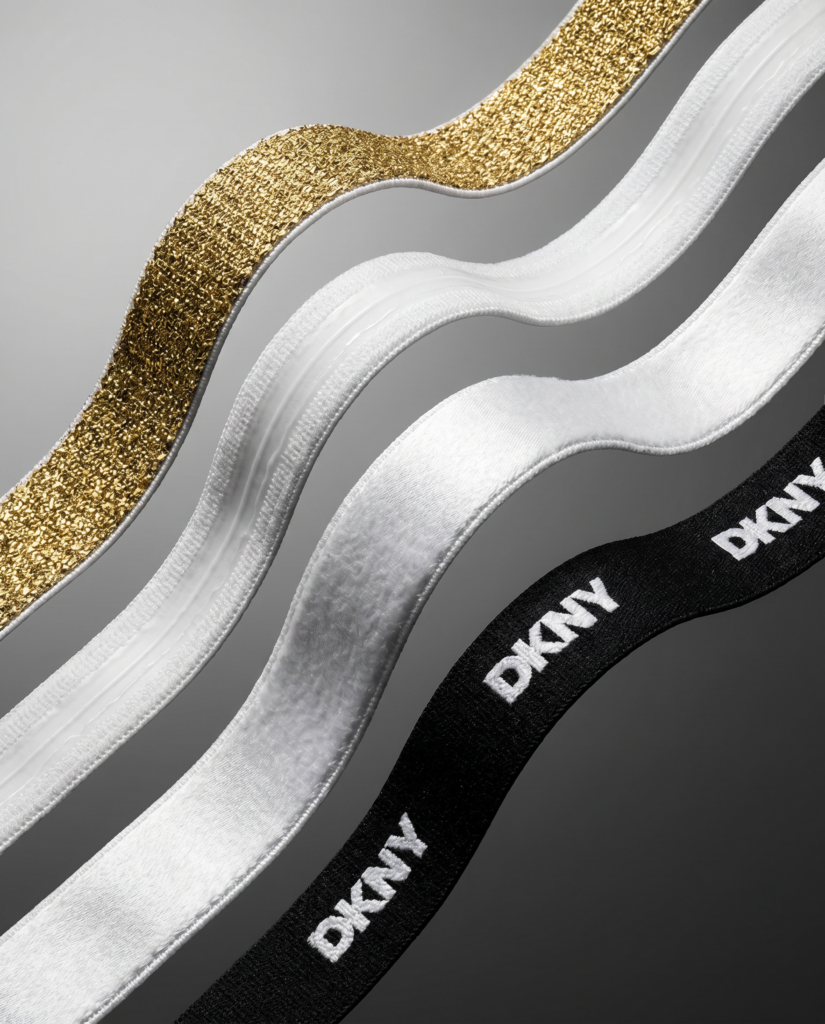
| Printed elastic | 10mm to 25mm | Brand identity on visible straps | Print must hold integrity across full stretch range and wash cycles |
| Embossed elastic | 12mm to 25mm | Premium texture finish | Heat and pressure process; verify it does not compromise stretch recovery |
Material composition follows a similar logic. Most elastic bra straps use a spandex or rubber core with a nylon or polyester covering yarn. Nylon is the standard for lingerie because it is soft, dye-receptive, and resistant to chlorine in wash cycles. Polyester is more heat-stable but has a harder feel against the skin. The denier of the covering yarn and the weight of the core determine the final weight, stretch profile, and durability of the finished strap.
For elastic band for bra underbands, the width runs significantly higher, typically 25mm to 75mm, because the underband carries the structural load of the garment. The stretch and recovery requirements for an underband are stricter than for a shoulder strap. Buyers sourcing both components should specify them separately with different performance criteria.
When Bras With Elastic Straps Make Sense and When They Do Not
Not every bra strap design uses elastic. Some use rigid ribbon, rigid satin, or firm woven tape with no stretch component. The choice between elastic and non-elastic strap construction is a product design decision that affects comfort, fit adjustability, manufacturing complexity, and price point.
Elastic straps work well when the garment needs to accommodate a range of shoulder widths within a single size, when the design requires the strap to move with the body during activity, or when the brand’s priority is comfort over structure. Most everyday lingerie, soft bras, and light sports bras use elastic straps for these reasons. The stretch-and-recovery behaviour of the elastic does the fitting work that a rigid strap would leave to the adjuster hardware.
Non-elastic straps are used when the garment requires a fixed strap length for structural reasons, when the design includes visible decorative elements that do not tolerate stretch, or when the strap is wide enough that elastic would create bulk at the shoulder. Some fuller-bust designs and structured corsetry use non-elastic strap constructions for these reasons.
For most lingerie and everyday bra production, bras with elastic straps are the manufacturing default because they are faster to sew, easier to size across a range, and more forgiving in production tolerances. The quality of the elastic in those straps is what determines whether the garment holds its shape, its colour, and its comfort rating through a product’s expected lifespan.
Material composition follows a similar logic. Most elastic bra straps use a spandex or rubber core with a nylon or polyester covering yarn. Nylon is the standard for lingerie because it is soft, dye-receptive, and resistant to chlorine in wash cycles. Polyester is more heat-stable but has a harder feel against skin. The denier of the covering yarn and the weight of the core determine the final weight, stretch profile, and durability of the finished strap.
For elastic band for bra underbands, width runs significantly higher, typically 25mm to 75mm, because the underband carries the structural load of the garment. The stretch and recovery requirements for an underband are stricter than for a shoulder strap. Buyers sourcing both components should specify them separately with different performance criteria.
What Drives the Price of Elastic Bra Straps at Wholesale Volume
Yarn quality is the largest single cost variable. Nylon covering yarn costs more than polyester. A higher-denier spandex core costs more than a lower-denier alternative. A supplier quoting significantly below market on a nylon-spandex elastic for bra straps is either using a different yarn blend or reducing spandex content below what the specification calls for. Both changes affect performance.
Dyeing adds cost and introduces the biggest supplier differentiation factor at the same time. White or greige elastic is the lowest cost option. Custom-dyed elastic in shades requiring multi-step dyeing costs more and takes longer. The critical variable is where the dyeing happens. A manufacturer with in-house dyeing controls the colour process from approval through bulk production. A manufacturer who sends elastic to an external dye house has less control over batch-to-batch consistency and lead times at that stage.
Order volume determines how much of the machine setup cost lands in the unit price. Every width change, yarn change, or colour change on a production machine involves setup that consumes time before the first usable metre is produced. Buyers ordering below efficient run lengths carry a disproportionate share of that cost per metre. Buyers ordering at scale spread it across a larger volume.
Elastic Bra Strap Specifications to Lock In Before Any Bulk Order
A wholesale order placed without a full specification is an invitation to disputes at goods receipt. These are the specs that need to be in writing before production begins:
- Width in mm, measured relaxed
- Construction type: woven, knitted, or fold-over
- Material: covering yarn type and denier, core type and weight
- Colour: Pantone reference or physical swatch with approved lab dip
- Maximum shrinkage after defined wash conditions
- Minimum elongation percentage
- Minimum recovery rate after a defined number of flex cycles
- Colour fastness to washing and rubbing, with a minimum acceptable rating
- Edge finish specification
- Packaging: roll length, core diameter, carton dimensions
Any spec left open defaults to whatever is most efficient for the supplier to produce. That is a reasonable thing for a supplier to do. It is a problem for the buyer.
How the Wholesale Sourcing Process for Elastic Bra Straps Actually Works
Most sourcing problems in elastic bra strap procurement happen at the handoff between sampling and bulk. A buyer approves a sample. Production begins on assumptions about what was approved. Bulk goods arrive and something is different. The way to prevent this is to understand what each stage of the sourcing process is actually confirming, and what it is not.
Step 1: Inquiry and brief
The inquiry stage sets the scope. A useful brief includes the construction type, width, material preference, colour reference, intended end use, target order volume, and delivery timeline. The more of this a buyer provides upfront, the more accurate the first sample will be. Suppliers who receive a vague inquiry produce a generic first sample. Generic samples are not useful references for bulk production.
Step 2: Development sample
The development sample is produced to the brief. Its job is to confirm the construction, the material combination, and the approximate colour direction. It is not a bulk production run. It is produced on a single machine in a short run, often from yarn stock that may differ slightly from what will be used in bulk. Approving a development sample confirms the direction. It does not lock the bulk production specification.
Step 3: Lab dip approval
For any dyed elastic bra strap, the lab dip is a separate and critical stage. The dye house produces a small dyed sample against the buyer’s colour reference. The buyer approves or rejects it. Bulk dyeing only begins after lab dip approval. Buyers who skip lab dip approval and proceed directly from a development sample to bulk production frequently receive bulk goods in a colour that has drifted from what they expected.
Step 4: Bulk production confirmation
Before bulk production begins, the specification should be fixed in writing: construction, material composition, width, colour reference with approved lab dip, shrinkage tolerance, elongation and recovery parameters, and packaging requirements. This document is the reference against which bulk goods are checked. Without it, goods receipt disputes have no agreed baseline.
Step 5: Pre-shipment quality check
A pre-shipment quality check against the agreed specification should happen before goods leave the manufacturer’s facility. For buyers working with a new supplier for the first time, this check is worth doing against lab test data, not just a visual inspection. Shrinkage, colour fastness, and modulus all need instrument-based testing to verify. Visual inspection catches obvious defects. It does not catch shrinkage that will appear in the first wash.
Sourcing Elastic Bra Straps from a Manufacturer vs a Distributor
Most buyers searching for bra elastic wholesale in India encounter a mix of results: direct manufacturers, trading houses that stock finished goods from multiple mills, and agents who represent manufacturers without holding inventory. The distinction matters more than it appears on a first inquiry.
| Factor | Direct Manufacturer | Distributor or Trader |
| Price per metre | Lower at volume; no middleman margin | Higher; includes trading margin |
| MOQ flexibility | Set by machine setup economics | Can be lower; draws from existing stock |
| Custom colour | In-house if dyeing facility exists | Depends on mill relationship; less control |
| Batch consistency | Controlled within one facility | Varies; may draw from multiple production runs |
| Lead time for custom orders | Longer; production runs to order | Shorter for stock items; longer for customs |
| Quality documentation | Produced in-house; traceable | Depends on what the mill provides |
| Accountability for defects | Direct; manufacturer is responsible | Split; trader may redirect to mill |
| Colour development | In-house lab dip process | Outsourced to mill; buyer is at one remove |
For a buyer placing a one-time order at low volume, a distributor can be a practical option because the MOQ is lower and the stock is ready. For a buyer building an ongoing product line where colour consistency across multiple production runs matters, sourcing directly from a manufacturer with in-house dyeing removes the variables that distributors introduce at the colour and quality stage.
The tradeoff is that manufacturers typically require higher minimum order quantities, longer lead times for first orders, and a more detailed specification upfront. Buyers who invest in that process once get a supplier relationship that holds quality across repeated orders. Buyers who optimise for the lowest possible barrier to a first order frequently find themselves resourcing the same product after the second or third run produces different results.
How Konika Manufactures Elastic Bra Straps
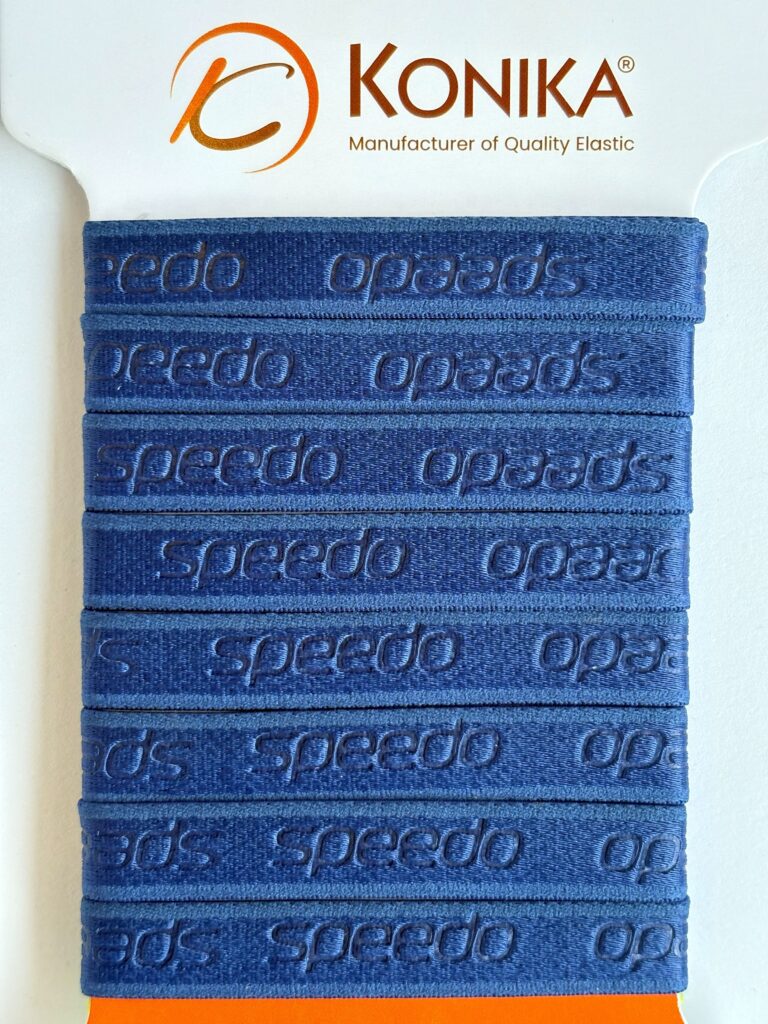
Konika Intima Pvt. Ltd. is a Surat-based lingerie elastic manufacturer established in 2012, operating at a production capacity of 20 million metres per month. The lingerie elastic range covers bra straps, underbands, wire casing, fold-over elastics, and knitted elastics, with in-house printing and embossing for buyers requiring branded or textured finishes. Konika Intima holds Oeko-Tex and GRS certifications.
In-house dyeing
Konika operates India’s largest narrow fabric dyeing facility, handling both yarn and elastic dyeing within the same facility. Colour matching runs against buyer-supplied Pantone references or physical swatches. A lab-dipped sample is produced and approved before any bulk dyeing begins. Because the entire process runs in-house, colour approvals, bulk production, and quality checks happen within one facility without handoffs to a third-party dye house. Batch-to-batch colour consistency is controlled at source.
In-house yarn texturizing
Three texturizing machines with a combined capacity of 250 tonnes handle both nylon and polyester yarn across multiple deniers. Controlling the yarn before it reaches the elastic production machines gives the process a level of raw material consistency that is difficult to achieve when yarn is sourced externally across multiple suppliers.
Laboratory testing
Every outgoing order, development samples included, is lab-tested before dispatch. Parameters tested cover basic physical specifications, flexing, colour fastness to washing, colour fastness to rubbing, shrinkage, modulus, elongation, and sublimation. Test results are produced in-house and form part of the quality documentation for each order.
Traceability
A barcoding system tracks materials through every stage of production. For buyers managing quality audits or investigating a production defect, the raw material batch origin for any finished goods lot can be identified.
Client base
Clients in the innerwear and lingerie segment include Jockey, Zivame, Nykaa, Van Heusen’s innerwear division, Lux, and Rupa. These brands run rigorous supplier qualification processes. Their ongoing sourcing from Konika reflects consistent performance across quality, colour, and delivery. Enquiries for samples, colour matching, and bulk orders: konikaelastics.com
Frequently Asked Questions: Elastic Bra Straps Wholesale
What is the difference between elastic band for bra and elastic for bra straps?
Elastic band for bra is the underband: the wide horizontal elastic that runs beneath the cups and provides the garment’s primary structural support. It carries the vertical load of the cups and back closure combined. Elastic for bra straps is the narrower vertical component connecting cups to the back. The two components carry different loads, use different construction types, and need different stretch and recovery specifications. An underband that rolls or folds under load is a structural failure. A shoulder strap with the same problem is a comfort failure. Both matter, both need separate specs.
What width should I specify for bra strap elastic wholesale?
Standard lingerie bra straps run 10mm to 18mm for fashion and everyday styles. Wider styles, from 20mm to 25mm, appear in fuller-bust and more supportive constructions. Sports bra straps typically run 25mm upward because they distribute load across a larger surface. The right width depends on the garment’s support structure and cup weight, not on aesthetic preference alone.
How do I avoid colour mismatch between elastic batches for bra making?
The root cause of batch-to-batch colour drift is almost always the dyeing stage. If a supplier outsources dyeing, colour consistency depends on a third-party dye house they cannot directly control across repeated production runs. Buyers sourcing the same colour across multiple orders should verify whether the supplier dyes in-house, what their colour approval process looks like before bulk production, and whether they can share lab dip data across batches as a standard part of order documentation.
What certifications matter when sourcing elastic for bra making?
Oeko-Tex Standard 100 confirms the elastic has been tested against a defined list of harmful substances. This is the baseline requirement for most European and US lingerie brands. GRS (Global Recycled Standard) is relevant for brands making recycled content claims. Some export markets also require REACH compliance documentation. Confirm certification requirements with your compliance team before supplier selection.
What is wire casing and when is it needed?
Wire casing is a tubular or channel elastic sewn into the lower edge of the bra cup to hold the underwire in position. The channel dimensions need to match the wire gauge precisely. The elastic must resist the lateral movement of the wire under load across the garment’s lifespan. It is a separate product from bra strap elastic and needs its own specification at the sourcing stage.